Everyone can save a life...!!! Don't put these skills off until after it's too late.
DAN: Divers Alert Network
• BLS/CPR & First Aid
• Neurogolucal Assessment
• Hazardous Marine Life Injuries
• Oxygen Administration for Scuba Diving Injuries
https://www.youtube.com/playlist?list=PLNBaXoals3bLIK-ejEAabNPjYDRED825q
#scuba #DAN #DiversAlertNetwork #CPR #BasicLifeSupport #FirstAid #EmergecyOxygen #HazardousMarineLifeInjuries
Tuesday, May 30, 2017

Finbert learns about solo diving
#finbert #solodiver #solodiving #scuba
solo diving course is now available... check it out here: https://jcaelitescuba.com/solo/diver.htm
Monday, May 29, 2017
Business as usual... if you aren't making enough money from your customers, lie to them...!!!
5/28/2017: UPDATE
email received (even though I unsubscribed): Sun, May 28, 2017 at 11:53 PMimage of the email: https://jcaelitescuba.com/human-factors/email-5-28-2017.jpg
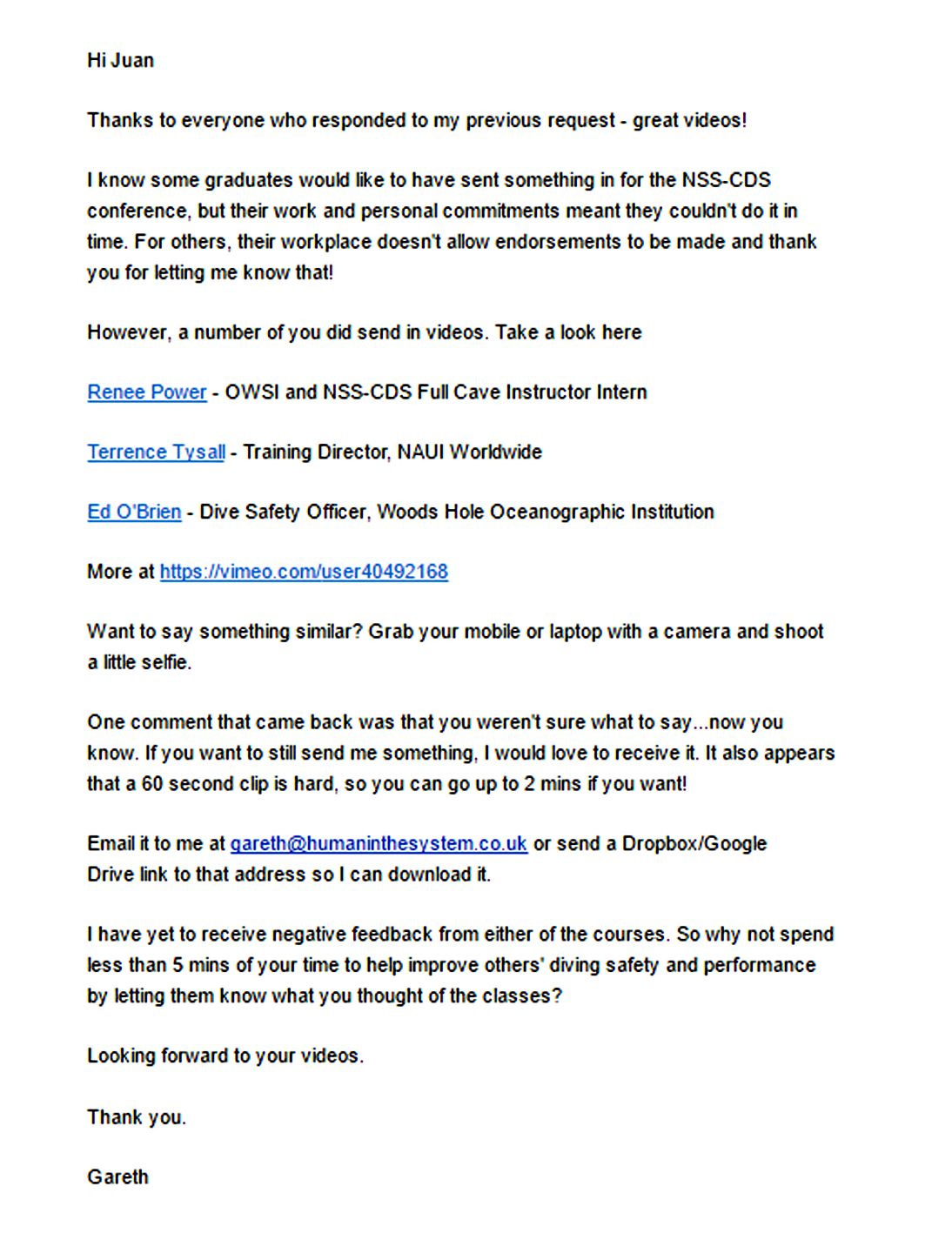
"I have yet to receive negative feedback from either of the courses. So why not spend less than 5 mins of your time to help improve others' diving safety and performance by letting them know what you thought of the classes?"
THAT IS NOT TRUE GARETH...!!! I GAVE YOU NEGATIVE FEEDBACK...
Yes, I am the ONLY one, but sending an email out that says you have yet to receive negative feedback, that is a lie! As far as your wish to "save me from the undue negative attention," I don't need to be protected. I've been very vocal about what is wrong with the dive industry and how to fix it. The problem continues to be that many are focused on "business as usual" and to change anything would result in negatively impacting their pocketbooks!
You have just did exactly that which I
detest; you lied to your customers!
At this point, I am literally ready to give up on scuba diving education! Your program is successfully moving through all of the major players in the scuba diving industry. Now, you have people making video reviews about their experiences with you! Here is a video review from Terrence Tysall, NAUI Training Director: https://vimeo.com/219218352
You have found a niche that I really think that needs to be addressed, but again, I can't emphasize enough to anyone that is actually going to hear it, this is NOT new. Where my frustration lies is that you are traveling around the world and sharing these insights and crap is still hemorrhaging out of the dive community. This doesn't mean that you are going to single-handedly going to be the catalyst we've needed, but that I want instructors, agencies, and dive shops to start treating students like people and get the target off their wallets. I believe everyone has the right to make a living, but if the part of industry that is responsible for divers dying won't do anything about it, scuba is dead!
5/7/2017: UPDATE ~ https://vimeo.com/216437186
Vimeo: Why ‘human error’ is a poor term if we are to improve diving safety. NAUI ICUE
"Presentation given by Gareth Lock and NAUI's ICUE 2017 event held at the Long Beach Scuba Show, LA. This thought-provoking and controversial presentation will focus on the need to change attitudes to human error in diving. Using audience participation exercises and diving case studies, he will show that the factors that we attribute to incidents and accidents are only really visible after the event because we are biased with hindsight and know what the outcome was, therefore we are able to join the dots to create the incident. However, in many cases, divers are unaware of which dots to look for, let alone that they will create a picture once joined up. Fundamentally, if ‘human error’ or ‘diver error’ appears in the conclusion of an accident or incident report, the investigation stopped too early. He will go on to explain how training which he has developed by taking the lessons learned from aviation and healthcare can improve individual and team performance in diving, making it a safer sport."
(my original video commentary)
#scuba #naui #humanfactors #TerrenceTysall #nauiICUE #HUMANinTHEsystem #humanfactorsskillsindiving #humanfactorsindiving #caveatemptor #garethlock
Sunday, May 28, 2017
Comment on, "Edgewater diver who drowned at Blue Spring still had air in tank" The deadly quarter turn back!
Yes! Always open the tank valve all the way... NO quarter turns backwards. #scuba #tankvalve #noquarterturnback NAUI has this written in their literature for some reason, but I teach to not do this...
The deadly quarter turn back!
An Edgewater diver who drowned at Blue Spring State Park had plenty of air in his tank but, its air valve was only partly open, according to a report from the Volusia County Sheriff’s Office.
By Frank Fernandez / frank.fernandez@news-jrnl.com
An Edgewater diver who drowned at Blue Spring State Park had plenty of air in his tank but its air valve was only partly open and he was not certified to dive as deep as he did, according to a report from the Volusia County Sheriff’s Office.
Samuel Slack, 36, drowned on Oct. 9 after he had a problem with his air supply and an attempt at buddy-breathing failed with his diving partner, Daniel Vansickle, 37, of New Smyrna Beach, according to reports. Slack "showed no signs of apparent or obvious injury" and the autopsy determined his death was an accidental drowning, the report states.
Keith Sterner, the owner of Sea Dog Dive Shop in New Smyrna Beach where Vansickle earned his open water and advanced certificate, said an out-of-air diver can quickly panic.
"It’s scary to see people panic," Sterner said. "You see grown men do things you wouldn’t think they’d do. A lot of times you can’t control someone in a panic and the best thing you can do is to save yourself."
Slack was the first diver to die at Blue Spring in Orange City since 2009 when Robert A. Jones, 38, of Zephyrhills drowned while "free diving" without air tanks.
Vansickle told investigators the men had been diving for several minutes and were about 80 feet deep when Slack made a "throat slash" gesture to show he was having trouble breathing, the report said.
Vansickle said he passed his regulator to Slack so he could breathe from it.
But when Vansickle motioned for the regulator’s return after about 30 seconds Slack held on to it, the report said. Vansickle told deputies he then pulled away from Slack, got control of the regulator and swam to the surface.
Once he surfaced, Vansickle yelled for a maintenance person to call 9-1-1, then dove back down and found Slack motionless in about 100 feet of water, the report states.
Vansickle could not be reached for comment.
Vansickle worked with Slack’s wife, Krystal, at The Garlic restaurant in New Smyrna Beach and had known Samuel Slack for about a year and a half, the report said.
Slack’s tank had about 2,100 pounds of pressure/air, the report states.
Corbin McKeon, an employee at Spruce Creek Scuba in Port Orange, said in a phone interview that depending on the type, tanks can hold from 3,000 to 3,500 pounds of air.
Slack’s tank valve "only turned less than one quarter (1/4) of a turn to shut off, this is not a normal operating position," the sheriff’s report states. Another part of the report said it turned only a quarter turn. Sterner said he teaches students to open the valve all the way, which can take several turns, and then turn it back a half-turn.
"If the valve isn’t open all the way, it can create labored breathing," Sterner said.
Slack had a novice open water diver card, meaning he was not certified to dive any deeper than 60 feet, the report states. Both Slack and Vansickle initialed a document at the park that they would not exceed the limit of the least certified of the two, meaning that they should not have exceeded the 60-foot depth.
Vansickle was certified as a cavern diver and his gear included an extra regulator to be used by a buddy to breath during an emergency.
But the additional regulator was under the chest straps of Vansickle’s "buoyancy vest, making the regulator unavailable if needed," the report states.
Each man’s wrist-worn dive computer showed they dove to 116 feet to the bottom of the spring and remained there for about 2 minutes.
They ascended to about 80 feet where both computers showed that they stopped for about a minute.
Slack’s computer shows he then descended to 90 feet and remained there for 8 minutes, the report said. Then Slack "immediately" rose to the surface.
Vansickle’s computer shows the same depths and then Vansickle rising to the surface as Slack remained at 90 feet.
The computer shows Vansickle immediately descending to 90 feet and then immediately returning to the surface. The computer information is consistent with Vansickle’s account and his decompression sickness.
An investigator tried to formally interview Vansickle, but on advice of his counsel "he refused to cooperate further during the investigation."
Looking for a Great Scuba Instructor is Like Looking for a Great Real Estate Appraisal
I currently have a student that is a real estate appraiser. He's been doing it since 2004. Today, we had an opportunity to talk about his business and how appraisals work. I found a lot of correlations between being a scuba diving instructor and an appraiser that I'm going to talk about in this blog.
I worked in the banking industry from 1996 to 2006 so I'm not unfamiliar with the appraisal process. During that time, as many of you might remember, home prices rose at an unprecedented rate! As all "bubbles" eventually burst, so did the housing market. 2008 was a bad year for home owners that needed the equity in their homes. Knowing how much a home is worth is dependent upon the real estate appraiser.
Contrary to common beliefs, appraisers go through a rigorous training process including a two year long apprenticeship. It's not just about spending time on the internet looking in the neighborhood for what others have sold their homes for, but for comparable upgrades, downgrades, landscaping, neighborhood conditions and many, many more aspects that are often unknown by the general public.
The appraiser is sometimes thought of as the "bad guy" because they are often the bearer of bad news. While experience creates consistency in the process and techniques an appraiser uses, once that foundation of experience exists, it can be counted upon to be consistent over time and not be compromised. In the process of buying and selling real estate, if someone wants to sell their home, in the end, it's only worth what someone is willing to pay. This "market value," especially today often comes at a premium to "appraised value" due to a lack in the supply of homes in areas well established without the land for new constructions.
Home buyers want values to come in low so that they pay less. Home sellers want their values to come in high as to make more money... All the while, banks want the value to come in where it should be as to minimize the risks involved in the fluctuating loan to value of said property. The appraiser's job is to be impartial so that everyone's best interests are insured, but the best interest of the economy is very important as well. Here are some similarities between the real estate appraisers and a scuba diving instructors I found fascinating.
When the consumer (prospective student) is ready to sign up for scuba diving lessons, often, one will do a search for and compare prices of lessons in the market they live in. Market prices sometimes influence what the dive shops (or independent instructors) can sell the lessons for. While prices vary in different parts of each respective town, they also vary from state to state, especially in land-locked states versus states (and to that extent, cities) that are near water.
One of the topics we talked about was the value of homes versus what people were paying for them. As home prices rise and availability decreases, buyers are often willing to pay more for a home than it's worth. Years ago, the purchase of a primary residence often meant that one would count on living there until the home was paid off, children were raised, moved out, off to college, etc. It is not unheard of that today's buyers will jump from home to home as they jump from job to job. Because of this, it is realistic to expect that the value of a home (a place to live, a place to raise a family, a place to retire to) -- the intangible investment that comes with home ownership -- is replaced by believing that a primary residence can be an investment vehicle! As what I expected would happen in 2008 saw my departure from the banking industry in 2006.
There is a preponderance of home buyers today, again are starting to believe that a primary residence makes a good financial investment. Family structures, career goals, financial goals, and changes in communities are occurring quicker the events that ran concurrently with home ownership that encompassed a traditional 30 year fixed-rate mortgage. In years past, home owners had time to wait out the highs and lows of market fluctuations. As the decades pass it was likely that one would expect a return on the cost of financing a home over a 30 year time frame. Today, there is little to no expectations that one will stay in a home for 30 years. Relatively speaking, it is unheard of! As lifestyles changes decrease from decades to years, so does the expectations of waiting out the tides of housing and financial markets.
Scuba once was an activity that took considerable more time to complete than the programs of today. The ability to choose from activities never before open to the general public that were few and far between, today are open to everyone. The instant gratification that comes from promises of learn today, dive tomorrow is because the industry created programs to meet "market" demand. The unfortunate side effect of speeding through an activity like scuba diving is that more drop out, more are less qualified, and more end up having to unlearn bad habits that might not have been learned in educational programs decades before.
There has been a movement in the industry to undervalue the price associated with learning how to scuba dive. While it is logical to conclude that when groups of students get larger and thus would influence the price of what each student pays, regrettably the prices have dropped but the cost of running the programs have not -- in fact they've gone up! What that means for the industry is that in order to finish the program and award certifications, programs that once had extensive training requirements and the months to learn, don't line up with today's students with limited time on their calendars. This means that programs ultimately became condensed and instructors took shortcuts. Programs that don't get the students in and out are thought of as outdated or inefficient.
While it is still possible to get adequate instruction at current market prices, as the old saying goes, you get what you pay for. It's no difference in real estate and it's especially true in scuba diving. It is reasonable to find that most dive shops will make so little profit on education that if it wasn't for equipment sales, they would no longer be in business. In order to maximize time and value, what ended up happening is that selling equipment became the priority and teaching became superfluous.
Value for services that are undervalued only result in one thing -- divers that don't know how to dive -- we are seeing it in today's students.
Here are some other correlations:
- Banks want to pay less to appraisers in favor of "automated value models" (electronic appraisals)
- Agencies become more receptive to e-learning and electronic methods of instruction
- Real estate agents put pressures on appraisers for higher and unjustified values so commissions are higher
- Dive shop owners put selling pressures on instructors to sell equipment as education doesn't have immediate or perceived value
- When experienced appraisers (receiving higher compensation) leave the industry, less experienced appraisers settle for smaller paychecks just to get a job -- get into the industry
- Dive shop owners pay less to their instructors due to increased operating costs, passing those expenses onto "up-and-coming" new instructors that settle for lower wages because of the touted "benefits" that come from working as a dive professional
- As experienced appraisers leave the industry, newer inexperienced appraisers enter that may be manipulated by lenders and real estate agencies
- As experienced instructors retire, they are replaced by younger instructors without the experiences that the wisdom of decades of diving and various situations brings
- Home buyers are paying inflated home prices that are contrary to prudent financial planning because of the belief that the benefits of "home ownership" are greater than the actual costs (and savings) associated with renting
- Dive shops entice prospective students into signing up with all inclusive (resort-style) training and pricing -- one low price that covers everything -- no investment in themselves as a diver that can't be continued upon returning home
- State and Federal regulators are influenced by banks, lenders, and the real estate markets to approve riskier lending and financial products with questionable underwriting standards
- Certifying agencies fail to hold their instructors accountable for failing to follow standards and training guidelines without repercussions because they are in the business of selling scuba, not making divers
Response to Cave Diver Harry's Facebook Post, "You may have noticed a couple things"
https://www.facebook.com/story.php?story_fbid=1952878454982592
• While I’m often critical of certain common teaching practices that can have an adverse effect on the environment or diver enjoyment, I seldom (if ever) label a particular teaching methodology as “unsafe.”
That being said, it begs the question, "Are a preponderance of divers that are seen in these videos FROM a 'certain' agency?" If so, why does this correlation exist?
• I also never comment on actual incidents that may have resulted in diver injury or fatality.
As social animals, it is inevitable we want to know what happened and why... we slow down on the highway to rubberneck all the time. As far as the number of fatalities, while scuba is dangerous, so is: rock climbing, bungee jumping, hang gliding, skiing, auto racing, bicycling, football, horseback riding, polo... Zero fatalities would be great, but that is unrealistic.
There is something to be said about "accident analysis" that can be used to help us not make the same mistakes we did before. Accident analysis was part of my cave training and I find it an invaluable tool in all fields, not just scuba. We think we won't make the same mistakes we did before, they did, or make the mistakes poorly trained divers make. This is called "hindsight bias." Because we saw, read, heard about that kind of accident/fatality that we won't repeat it because we know about it, but it continues to happen...
• Why is that? It’s because our friends in the legal profession regularly cruise social media looking for ammunition they can use when suing dive instructors. And we are all paying for it.
I think the industry's insurance is expensive because insurace companies want to make mconey. To that extent, if instructors stop doing stupid shit, if fatalities fell into the category of freak accident, then scuba liability insurance might not be as expensive as it should be.
As I write in one of my blogs, I think that families pursuing financial compensation to activities their loved ones entered willingly is wrong as well. I've made it perfectly clear that in the event of my death while diving, no one should pursue legal actions. I fully accept the risks involved, I even understand that a few out there might even cut corners, however, I have done my due dilligence, I have made educated decisions, and I chose to go diving! If I die diving, I ONLY want to be remembered for the things I contributed to scuba, not the one mistake I made.
• I just got my bill for liability insurance for the coming year. As expected, it is going to be in excess of US$1,000. And even though this is nearly twice what I was paying just a few years ago, I’m not complaining. I’m just happy to be able to get it at all.
I think mine has doubled in the last 10 years too, however my automobile insurance has always gone up and I have no tickets, accidents, or claims. It is the cost I have to pay to drive.
Similarly, when I did my crossover from SSI to NAUI, my course director went over the costs of being an instructor. I never got that at SSI. If the instructor doesn't make a business plan setting dollars aside for unforseen repairs, annual dues, liability insurance, program supplies, to what extent do they expect to remain in business? Some do a better job of running a business as a business, while others insist on teaching for free or close to it. I will make money teaching scuba. I will not do it for free!
• The number of carriers willing to insure diver training have been steadily declining. It wouldn’t take much for it to simply become unavailable. If that happens, few of us are likely to be willing to teach scuba when the cost of doing so could be everything we own and everything we are likely to make for the balance of our lives.
If the insurance industry left us, wouldn't it be prudent for the certifying agents to create their own form of safeguards against potential damages? Perhaps union style dues? That money to be set aside like insurance monies are? Maybe even partner with everyone in the industry to work on legislation to cap claims on financial awards? We have attornies creating the liability releases... What is the purpose of those?
• So, by all means, keep posting about how “unsafe” you think certain instructors, dive operations or training agencies are. Keep playing armchair quarterback, passing judgement on recent fatalities about which you actually know very little.
That does make for an interesting dilemma. I don't recall industries evaporating because of people's opinions but I have seen how reviews from sites like yelp have impacted individual businesses... I see reviews two different ways. Are merchants providing the services the consumers are looking for which warrant only 5-Star reviews? Bringing to the industry and emphasizing what the consumer can expect... or, are the reviews a reflection of what has already happened in the industry -- the merchants have disenfranchised the consumer with expectations beyond what can actually be delivered? -- that everyone can become a diver this weekend.
Reviews also don't seem to turn the consumer away when others warm them of certain business practices. In all, I believe the relationships people develop with each other will be the greatest hedge against frivolous law suits. Integrity, trust, accountability, and respect are earned -- NOT GIVEN!
• It doesn’t matter that, in so doing, you may be contributing to the end of diver training as we know it. Because, when that happens, people will just teach themselves by watching videos like this on You Tube.
Perhaps, however mentors, artisans, masters, and the exceptionally skilled have always been sought out even when cultures might be moving in a different direction. The Socratic Method is a great way to teach and to learn. I do have to say, I don't find a plethora of videos showing and criticizing GUE, IANTD, NSS-CDS, NAUI, TDI, BSAC, or even YMCA... I believe there is a reason for it.
Today's culture has strongly moved towards the inclusion of "everyone." In the workplace, education, social dynamics, and religion, I think this is a good thing. But, to include everyone in scuba is wrong. The primary reason is that many can't do it well enough to not hurt themselves. Sorry, but if it is likely you are going to kill yourself or others undergoing an activity, you should not do it and if your feelings are hurt when you don't get that c-card, too bad. I will not award anyone a certification card just because they paid for training.
Thank you for the continued perspectives, Harry!
Saturday, May 27, 2017
THE PLURAL OF OCTOPUS IS OCTOPUSES YOU IGNORANT SLOB
#octopus #octopuses #ignorantslob
https://www.merriam-webster.com/video/octopusyoutube.com
THE PLURAL OF OCTOPUS IS OCTOPUSES YOU IGNORANT SLOB
https://www.merriam-webster.com/video/octopusyoutube.com
Subscribe to:
Posts (Atom)
NEW VS. USED SCUBA EQUIPMENT; Which should you buy?
NEW VS. USED SCUBA EQUIPMENT Which should you buy? How much is a 10 year old piece of scuba equipment worth today on eBay? Take the r...

-
Yes! Always open the tank valve all the way... NO quarter turns backwards. #scuba #tankvalve #noquarterturnback NAUI has this written in t...
-
 DOWNLOAD CALCULATOR CLICK HERE For those that haven't used tables in a while, you can watch my two videos on Dive Tables by cl...
-
 If you are traveling to an international location, please read my blog, " Checklist for Referral Divers for their dive destinati...